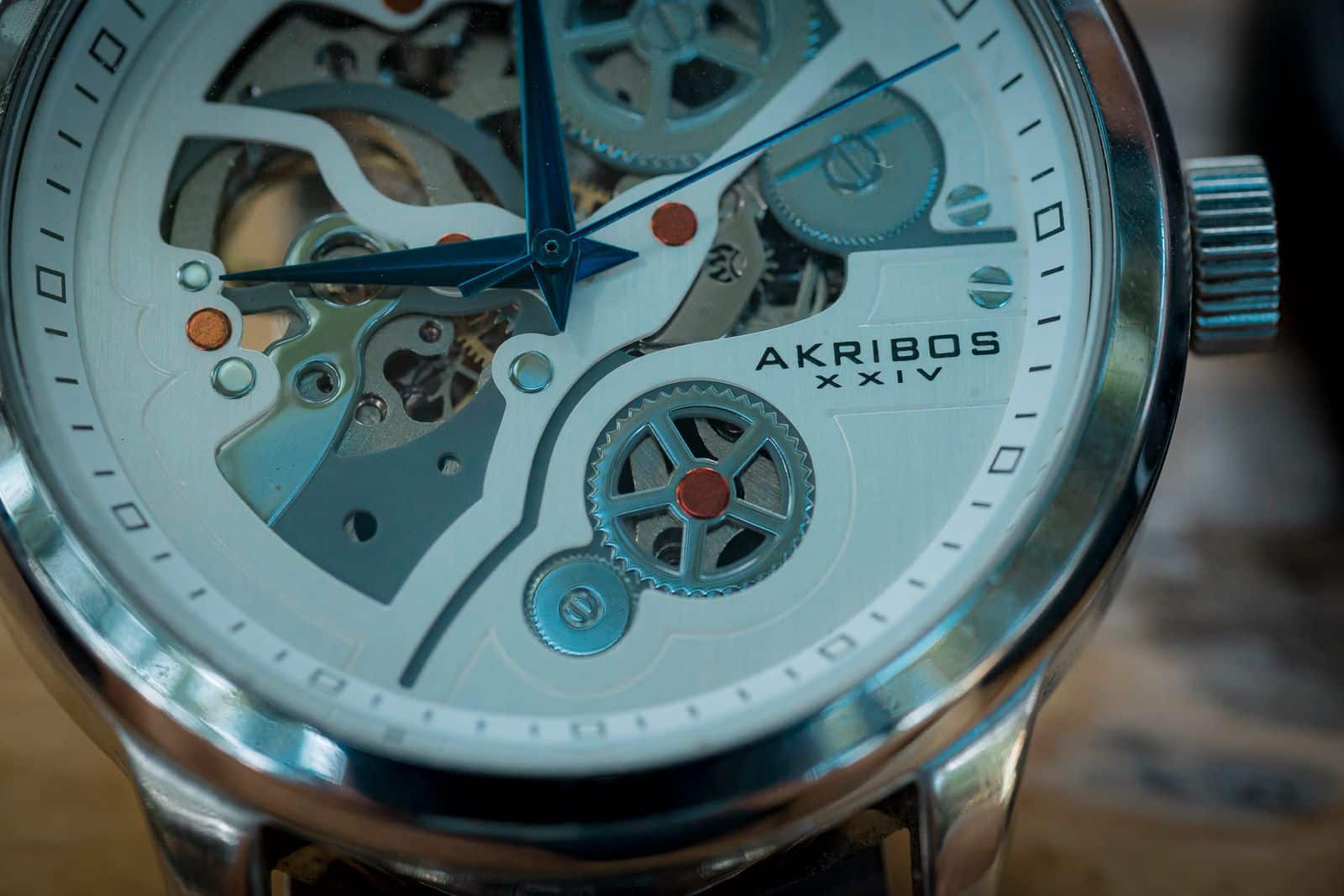
Turn over a mechanical watch with a display caseback and you get a working machine of a couple of hundred parts, most of them smaller than a grain of rice. To a newcomer it looks like a blur of gold and steel. To a collector it reads like a spec sheet: how the watch is powered, how carefully it was made, and roughly what tier of maker built it.
You don’t need a loupe or a watchmaker’s training to read the basics. This guide covers the parts you can identify by eye, the finishing techniques that separate mass production from hand work, and the questions worth asking before you pay a premium for what’s inside.
First, identify what kind of movement you’re looking at
Every watch is driven by one of three broad types of movement. Knowing which one you have frames everything else.
- Quartz: powered by a battery, regulated by a vibrating quartz crystal. Very accurate and cheap to run. The seconds hand usually ticks once per second. Most quartz watches have solid casebacks because there’s little to look at.
- Manual-wind (hand-wound) mechanical: powered by a coiled mainspring that you wind with the crown. No rotor, so the whole movement is visible through a display back, which is why many high-end dress watches use them.
- Automatic (self-winding) mechanical: the same as manual-wind, plus a weighted rotor that swings as your wrist moves and winds the mainspring for you. Most automatics can also be wound by hand.
On a mechanical watch the seconds hand sweeps in small steps rather than jumping once a second. That alone tells you a lot before you ever look at the back.

The parts you can spot by eye
The rotor
On an automatic, the rotor is the large half-moon weight that covers part of the movement. It’s often the most decorated part because it’s the most visible. Look at how it’s finished, whether it carries engraving or a maker’s crest, and whether it spins smoothly and quietly. Some makers use a micro-rotor set into the movement or a peripheral rotor around its edge so more of the mechanism stays visible; both are harder to engineer and tend to appear on more expensive pieces.
The balance wheel and hairspring
This is the heartbeat: a small wheel oscillating back and forth, controlled by a fine coiled spring. It’s the part you’ll see moving constantly. The balance and hairspring regulate how fast the watch runs, so their quality has a direct effect on accuracy. Look at whether the balance is held by a bridge (supported on both sides) or a cock (supported on one side). A bridge is generally considered sturdier.
The escapement
Next to the balance you’ll see the escape wheel and a small pallet fork flicking back and forth. This is what releases the mainspring’s energy in controlled steps and produces the ticking sound. You won’t judge its quality by eye, but it helps to know where it is when a seller starts talking about “silicon escapements” or “co-axial” designs. Those are real engineering differences, aimed mostly at reducing friction and the need for lubrication.
Jewels
The small red or pink dots are synthetic rubies used as bearings where metal parts would otherwise rub. A typical automatic uses somewhere around 21 to 28. More is not automatically better; past the number the design needs, extra jewels add little, and very high counts on cheaper watches are often marketing.
Plates, bridges and the barrel
The flat structures holding everything together are the main plate and bridges. The mainspring sits in a round, toothed drum called the barrel. Two barrels, or a noticeably large one, usually means a longer power reserve.
Reading the finishing: where the hours go
Finishing is decoration applied to parts that would work just as well without it. That’s exactly why it’s a good proxy for care: nobody spends hours on it unless the whole watch was built to a higher standard.
| Finish | What it looks like | What it tells you |
|---|---|---|
| Côtes de Genève (Geneva stripes) | Parallel wavy stripes across bridges and rotor | Common at many price levels; check that stripes line up cleanly across separate parts |
| Perlage | Overlapping small circles, often on the main plate | Usually machine-applied; even spacing suggests care |
| Anglage (beveling) | Polished, angled edges on bridges | Hand beveling, especially inward-pointing corners, is costly and a mark of high-end work |
| Blued screws | Screws heat-treated to a deep blue | Traditional detail; even color matters more than its presence |
| Black polish | Mirror-flat surfaces that look black or white depending on the angle | Rare and labor-intensive, found mostly in top-tier watches |
| Plain or lightly brushed | Little or no decoration | Normal for tool watches and value pieces; says nothing bad about reliability |
A practical test: tilt the watch under a lamp. Hand-finished bevels catch light in a clean, continuous line. Machine finishing looks crisp but uniform, and corners are rounded rather than sharp. Neither is wrong, but they belong at very different prices.

The numbers worth understanding
Beat rate
Measured in vibrations per hour (vph) or hertz. Common rates are 21,600 vph (3 Hz) and 28,800 vph (4 Hz), with a few movements running at 36,000 vph (5 Hz). Higher rates give a smoother sweep and can help stability, but they also mean more wear and sometimes shorter power reserve. A lower beat rate is not a flaw.
Power reserve
How long the watch runs from a full wind, often around 38 to 50 hours for traditional calibers and 70 hours or more for many newer ones. A longer reserve matters if you rotate watches or take one off for the weekend.
Certification
A chronometer certificate from COSC, the Swiss testing body, means the movement was tested over several days in different positions and temperatures and met its accuracy standard. Some makers add their own, stricter in-house or third-party testing of the finished watch. Certification is a useful signal, but an uncertified watch from a good maker that has been regulated well can be just as accurate in daily wear.
In-house versus sourced movements
“In-house” means the brand designed and makes its own movement. “Sourced” means it buys a movement, often from a large specialist manufacturer such as ETA, Sellita, Seiko or Miyota, and may modify or decorate it.
In-house movements show capability and investment, and they let a brand do things others can’t. But a well-proven sourced movement is often cheaper to service and easier to find parts for, which matters over decades of ownership. Be skeptical of a large price premium charged purely for the in-house label. Ask what the movement actually does better.
From experience: Over the years I’ve come to believe in buying from makers with real provenance and real technology, ones that focus on one thing and do it well. A display caseback is where that shows. When the movement is cleanly engineered and finished with care, you’re seeing the maker’s priorities directly instead of taking the marketing’s word for it.
A quick movement-reading checklist
- Identify the type: quartz, manual-wind or automatic.
- Find the balance wheel and check that it’s swinging smoothly with a steady rhythm.
- Look at the finishing on edges and corners, not just the stripes.
- Note the beat rate and power reserve from the maker’s specifications.
- Ask whether the movement is in-house or sourced, and what that means for servicing.
- Check the service history and recommended service interval before you buy.
For the wider picture of judging any watch, see our guides to watch complications, buying a watch for heirloom status, and how to judge quality before you buy anything.
FAQ
Does a display caseback reduce water resistance?
Not necessarily. Many sapphire display backs are rated to the same depth as solid ones. Check the stated rating, and have seals tested at each service.
Should I open my watch to look at the movement?
No. Opening a solid caseback without the right tools and a clean environment risks scratches, dust and compromised seals. Use a display back, the maker’s photos, or a watchmaker.
Is a more decorated movement more reliable?
Decoration and reliability are separate. Finishing shows care and cost; reliability comes from design, regulation and regular servicing.
Updated November 2026. Some links on this site may be affiliate links; see our editorial policy.