Cufflinks and tie bars are among the few accessories that are both functional and decorative. A tie bar keeps your tie in place; cufflinks fasten a shirt cuff that has no buttons. Worn well, they make a suit look considered. Worn badly, too big, too shiny or in the wrong place, they’re the first thing people notice for the wrong reasons.
This guide covers when to wear each, the main types, how to match metals and how to place a tie bar correctly, plus a short checklist and answers to common questions.

Start with the shirt: cuff types decide what you can wear
Cufflinks only work with cuffs that have buttonholes on both sides and no buttons. There are three common cuff types:
- Barrel cuff: the everyday cuff with one or two buttons. It doesn’t take cufflinks.
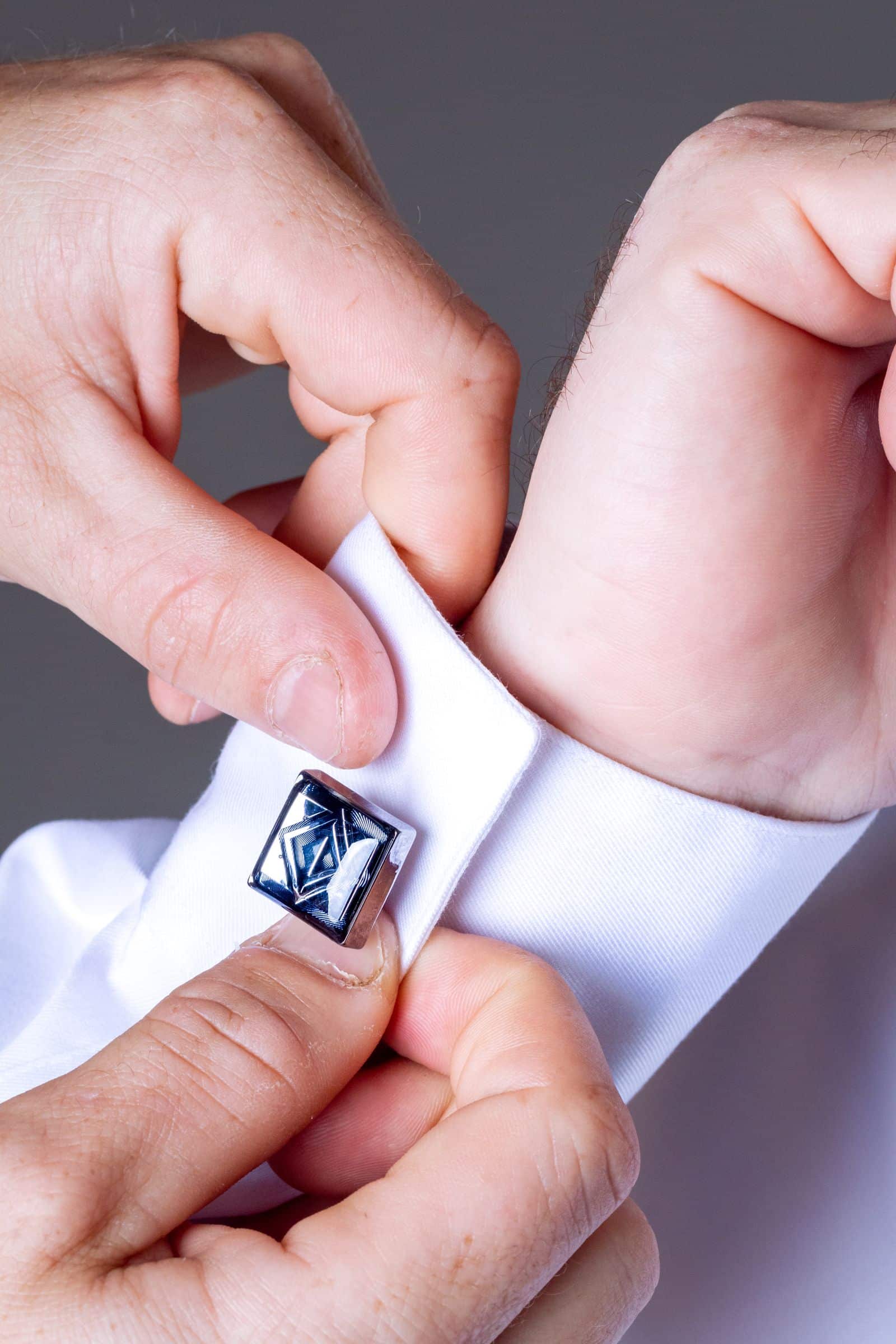
- French (double) cuff: a long cuff folded back on itself and fastened with cufflinks. It’s the most formal option and the one required for black tie.
- Convertible cuff: has a button and a second buttonhole, so it can be worn with either the button or a cufflink. It’s a good compromise for travel.
When you fasten a French cuff, press the two inside edges together (like a kissing pair of lips) rather than overlapping them like a barrel cuff. That’s the traditional way, and it shows the decorative face of the cufflink on the outside of the wrist.
The main types of cufflinks
| Type | How it fastens | Best for | Notes |
|---|---|---|---|
| Bullet back / toggle | A swiveling bar flips to lock | Everyday business wear | The most common and easiest to use |
| Whale back | A fixed post with a hinged flat back | Business and formal | Very secure; slightly fiddly at first |
| Fixed back | One solid piece, no moving parts | Formal and heirloom pieces | Durable but hard to push through tight cuffs |
| Chain link | Two faces joined by a short chain | Formal and vintage looks | Traditional; both sides are decorative |
| Silk knot | Two knotted cord balls joined together | Casual or creative offices | Inexpensive and colorful; not for black tie |
For a first pair, choose a simple bullet-back or whale-back design in silver or a silver-toned metal with a plain, oval or rectangular face. It will work with nearly any shirt and suit.
Tie bars, tie clips and tie chains
A tie bar does one job: it holds the front and back blades of your tie to your shirt placket so the tie doesn’t swing into your food or blow over your shoulder. The terms are often used loosely:
- Tie bar (slide): a folded metal bar that slides on and grips by tension. Simple and secure.
- Tie clip: a hinged clip that opens and closes. It holds well but can mark delicate silk if clamped too hard.
- Tie chain: a chain hangs across the front of the tie while a bar behind it attaches to the shirt. It’s decorative and suits vintage looks.
How to wear a tie bar correctly
- Height: place it between the third and fourth buttons of your shirt, roughly level with your sternum. Too high looks odd; too low disappears behind a buttoned jacket.
- Width: it should be narrower than the tie at that point, ideally about half to three-quarters of the tie’s width. A bar that sticks out past the edges is the most common mistake.
- Clip the shirt too: it must catch the shirt placket as well as both blades of the tie, or it’s just decoration.
- Keep it level: straight across, or angled very slightly downward.

Matching metals and keeping it restrained
A simple rule keeps everything coherent: match your metals. If your watch case is steel, choose silver-toned cufflinks and tie bar; if it’s gold, go gold. It’s also worth matching your belt buckle when you can. Our guide to a belt you buy once covers buckle finishes.
- Wear one statement piece at most. Bold cufflinks plus a patterned tie bar plus a busy pocket square is too much.
- Polished, brushed and matte finishes all work; avoid mixing high-shine and matte metals in the same outfit.
- Novelty cufflinks (logos, cartoons, gadgets) are for casual settings, not interviews or funerals.
Formal events and black tie
Black tie traditionally calls for a dress shirt with French cuffs, simple cufflinks and matching shirt studs in place of buttons. Onyx, mother-of-pearl or plain polished metal are the classic choices. A tie bar is not worn with a bow tie. For how dress codes differ, see reading dress codes correctly.
From experience: My oldest piece of clothing is a Christian Dior tuxedo from the 1980s, and it’s still in great condition. Classic formalwear doesn’t need updating every few years, and neither do the small pieces worn with it. A plain, well-made pair of cufflinks will look as right decades from now as it does today.
From experience: My worst purchase was a Cuban silver chain. It was fine when I was young, but it dated very quickly. That’s the risk with trendy jewelry of any kind, cufflinks included: the more of-the-moment it looks, the shorter its life.
What to look for when buying
- Solid metal or quality plating: sterling silver and solid gold last longest; plated pieces can wear through at the edges with frequent use.
- A firm mechanism: the toggle or whale back should snap into place, not flop loosely.
- Clean finishing: no rough edges, visible glue or loose stones.
- A tie bar with real grip: it should hold without needing to be clamped so hard that it creases the silk.
The same checks apply to almost any purchase. Our guide on how to judge quality before you buy explains them in more detail.
Quick checklist
- French or convertible cuffs for cufflinks; barrel cuffs don’t work.
- Tie bar between the third and fourth shirt buttons, narrower than the tie.
- Match metals with your watch and, ideally, your belt buckle.
- One statement piece at most; simple designs for formal settings.
- Studs and cufflinks for black tie; no tie bar with a bow tie.
FAQ
Can I wear a tie bar with a skinny tie?
Yes, but choose a short bar so it stays narrower than the tie. A full-length bar on a narrow tie will stick out past the edges.
Should I wear a tie bar if I keep my jacket buttoned?
It’s optional. A buttoned jacket already holds the tie in place and may hide the bar. Tie bars matter most when you take your jacket off or don’t wear one.
Are cufflinks too formal for everyday office wear?
Not if they’re simple. Plain silver or knotted silk cufflinks are fine in many offices. Save larger or more decorative styles for formal occasions.
Updated November 2026. Some links on this site may be affiliate links; see our editorial policy.