Most belts are thrown away for the same few reasons: the leather cracks at the holes, the surface layer peels off, or the buckle’s plating wears through to dull gray metal. All three are signs of how the belt was made, not how hard it was used. A properly made leather belt can be worn almost daily for decades.
Here’s how to tell the difference in a store or from a product listing, how to size and match a belt, and how to care for one so it keeps going.

Why cheap belts fail
Many inexpensive belts aren’t one piece of leather. They’re made from a thin top layer glued to a backing of split leather, bonded leather or fabric, with the edges painted to hide the seam. It looks fine on day one. After months of bending at the buckle and the holes, the layers separate, the edge paint cracks, and the belt starts to curl or peel.
A belt built to last is usually cut as a single strip from a thick, full-grain hide. There’s nothing to delaminate. It flexes, darkens and softens with wear, and the worst that typically happens is a hole stretching, which a leather shop can fix or move.
What to look for in the leather
- Full-grain, single-ply leather. Look for listings that say full-grain and describe the belt as one piece or single layer. If you can see a distinct seam or different material along the edge, it’s layered.
- Thickness. Sturdy casual belts are often around 3–4 mm thick (roughly 8–10 oz leather). Dress belts are thinner and sometimes lined, which is acceptable when the lining is leather and stitched, not just glued.
- Bridle or harness leather. These are vegetable-tanned leathers finished with oils and waxes, originally for horse tack. They’re dense, resist moisture better than plain veg-tan and are a traditional choice for belts.
- Avoid “genuine leather” and bonded leather for a belt you want to keep. The terms usually mean lower-grade layers or reconstituted scraps.
Buckles: the part people forget
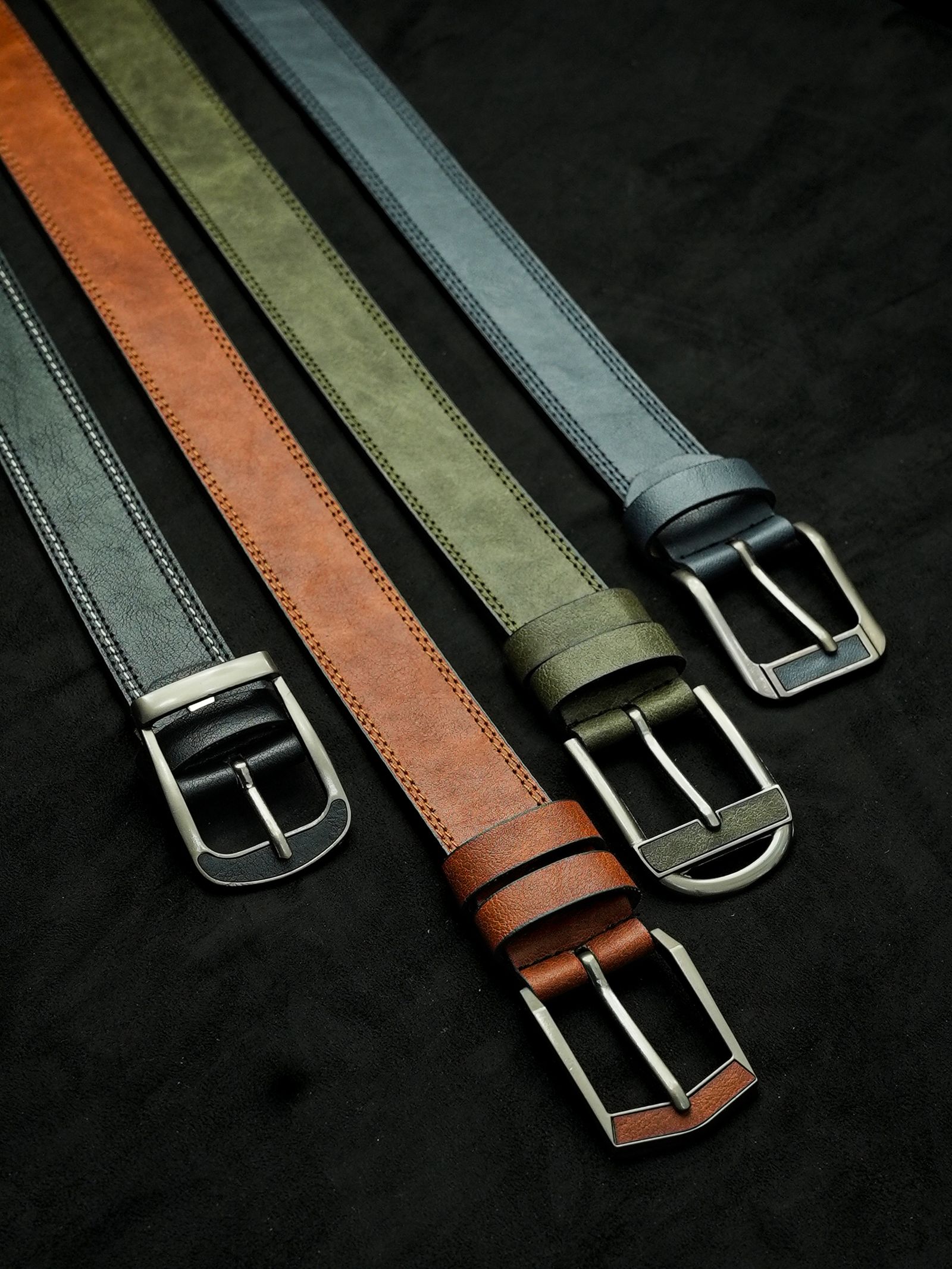
A great strap with a poor buckle still disappoints. Solid brass and stainless steel buckles hold up for decades; brass develops a patina and can be polished. Many cheap buckles are cast zinc alloy with a thin plating that chips and wears through.
Look for a buckle attached with screws or snaps rather than permanently stitched or riveted. That lets you swap buckles to change the look, replace one that breaks, or move a good buckle onto a new strap years later.
Width, size and color
| Belt type | Typical width | Worn with | Leather finish |
|---|---|---|---|
| Dress belt | About 1–1.25 in (25–32 mm) | Suits, dress trousers | Smooth, polished, slim buckle |
| Everyday belt | About 1.25–1.5 in (32–38 mm) | Chinos, smart casual | Smooth or lightly textured |
| Casual/jeans belt | About 1.5 in (38 mm) | Jeans, work trousers | Thick, matte or oiled, sturdier buckle |
Check your trouser belt loops before buying; a wide casual belt won’t fit through slim dress-trouser loops. For sizing, most makers measure from the buckle fold to the center hole, and a common rule is to buy one to two inches above your trouser waist size. When in doubt, measure a belt you already own that fits well and compare it with the maker’s size chart.
For color, two or three belts cover most wardrobes: a black dress belt, a dark brown dress or everyday belt, and a sturdier medium or dark brown casual belt for jeans. The traditional guideline is to keep your belt leather close in color to your shoes and your buckle metal roughly in line with other metal you wear, such as a watch case. It’s a guideline, not a law. If you’re building out those shoes, see the only three pairs of shoes a man truly needs.
From experience: If I were advising a 25-year-old, I’d tell him to buy pieces that last. Vintage is fine, and mixing and matching is perfectly fine. A good secondhand belt in thick, single-piece leather is often a better buy than a new layered one, and you don’t need a perfect match for every outfit.
When to skip a belt altogether
Some trousers are designed to be worn without a belt. Suit trousers with side adjusters (small buckles or tabs at the waistband) or buttons for suspenders don’t need belt loops at all, and adding a belt to them looks cluttered. If your trousers have no loops, that’s intentional. For everything with loops, wear a belt; empty loops tend to look unfinished.
Fit matters here too. A belt shouldn’t be doing the work of holding up trousers that are too big. If you have to cinch hard and the waistband bunches, have the trousers taken in by a tailor instead.
Where to find a lasting belt
Heritage leather makers such as Filson and Tanner Goods sell single-piece belts, and many independent leatherworkers make them to order in your size. Vintage and thrift stores are also worth checking: a decades-old belt that hasn’t cracked has already proved itself. Whatever the source, apply the checks above rather than relying on the brand. Our guide on how to judge quality before you buy covers the same principles for other purchases.
How to care for a leather belt
- Rotate. Giving a belt a day off lets the leather relax and dry out.
- Store it flat or hung by the buckle, not tightly coiled for long periods.
- Condition once or twice a year with a leather conditioner or balm, applied lightly and buffed off. Test on the back first, since it may darken the leather.
- Dry it slowly if it gets soaked. Never use a heater or hair dryer.
- Fix holes early. A leather repair shop or cobbler can punch new holes or shorten a belt, which is far cheaper than replacing it. See why a good cobbler is a lifelong ally.
Key takeaways
- Choose full-grain, single-piece leather; avoid layered, bonded or “genuine leather” belts.
- Pick solid brass or stainless steel hardware, ideally with a removable buckle.
- Match the width to your trouser loops and the formality of the outfit.
- Two or three good belts are enough for most men.
- Look at vintage; a belt that has lasted decades already passed the test.
FAQ
How can I tell if a belt is layered?
Look at the edge. A single-piece belt shows the same fibrous leather all the way through. A layered belt often shows a line where two materials meet, a fabric or foam core, or a thick coat of paint covering the edge entirely.
Do I need a different belt for every pair of shoes?
No. A black dress belt, a brown dress belt and a casual brown belt cover most situations. Close is good enough; exact color matches are rarely necessary.
Can a cracked belt be saved?
Surface dryness can often be improved with conditioner, but deep cracks through the leather or separating layers usually can’t be fixed. That’s why construction matters most at the time of purchase.
Updated November 2026. Some links on this site may be affiliate links; see our editorial policy.