Two jackets can look identical on a hanger and be completely different garments. One is built to mold to your body and last for years; the other is glued together and will look tired after a few seasons. The difference is in details most shoppers never check, partly because retailers rarely point them out.
You don’t need to be an expert to spot them. This guide covers the construction details that most reliably separate well-made clothing from merely expensive clothing: selvedge denim, jacket canvassing, buttons, stitching, pattern matching and linings. Each comes with a quick check you can do in a store.

Why construction details matter
Marketing focuses on brand, heritage and lifestyle images, none of which tell you how a garment is built. Construction tells you how a piece will wear, whether it can be repaired, and how it will look after years of use. It also helps you avoid paying a premium for a label alone.
From experience: In over 20 years of helping people find quality clothing and outfitter goods, one thing I’ve seen again and again is that many brands share the same manufacturers. High-end labels are often made by the same people who make discount goods. That’s why I look at how a piece is made rather than whose name is on it.
Selvedge denim: the edge tells the story
Selvedge (or selvage) means “self edge.” It’s the tightly woven, finished edge of fabric produced on traditional shuttle looms, which weave narrower cloth with a continuous weft thread that loops back at each side. The result is a clean edge that doesn’t fray, often marked with a colored line.
Most modern denim is woven on faster, wider projectile looms that leave a loose, cut edge, which has to be overlocked to stop fraying.
How to check
Turn up the cuff of a pair of jeans and look at the outseam. Selvedge jeans show a neat, finished band along the seam. Non-selvedge jeans show a zigzag overlock stitch.
What it does and doesn’t mean
Selvedge indicates a slower, more traditional weaving process, and it often goes along with heavier, denser denim. It doesn’t guarantee good fit, good dye or good sewing. Treat it as one sign among several, not proof of quality on its own. For more on choosing jeans that last, see our guide to raw denim.
Canvas: what’s inside a jacket
A tailored jacket has an interior layer between the outer fabric and the lining that gives the chest its shape. How that layer is attached is one of the biggest quality differences in menswear.
| Construction | How it’s made | How it wears |
|---|---|---|
| Full canvas | A canvas layer (traditionally wool and horsehair) runs the full front, attached with stitching | Molds to your body over time; drapes naturally; most durable; most expensive |
| Half canvas | Canvas in the chest and lapel only; the lower front is fused | Good shape and lapel roll at a lower cost; a sensible middle ground |
| Fused | An interlining is glued to the outer fabric | Stiffer; can bubble or separate over time, especially with heat or cleaning |
The pinch test
Gently pinch the fabric of the jacket front a few inches below the top buttonhole and pull the outer fabric and lining slightly apart. If you can feel a separate, loose third layer floating between them, the jacket has canvas there. If the outer fabric feels stiff and seems stuck to a single layer, it’s fused. Repeat lower down on the front to tell half canvas from full canvas.
Look at the lapel roll
A canvassed lapel tends to curve softly where it folds over. A fused lapel often looks flatter and more pressed, as if it were creased with an iron.
Horn, corozo and plastic buttons
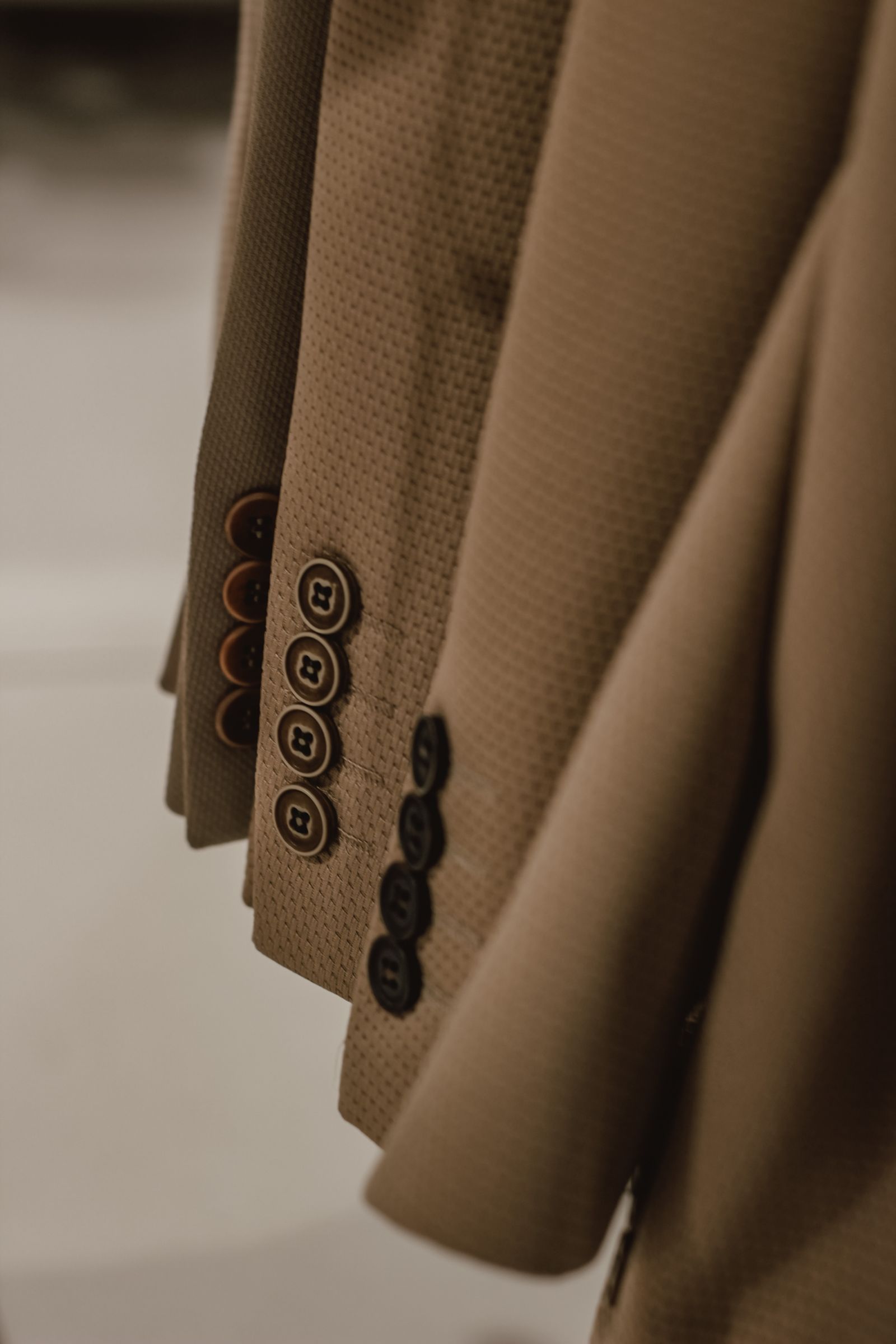
Buttons are a small detail that hints at how much care went into the rest of a garment.
- Horn buttons are cut from natural animal horn. Each one has slight variations in color and grain, and they feel solid and cool to the touch.
- Corozo buttons are made from the nut of a palm tree. They’re durable, take dye well and are common on quality suits and coats.
- Mother-of-pearl buttons on shirts are thick, have a natural iridescence and feel cool.
- Plastic buttons are often molded to imitate horn. The giveaway is a pattern that repeats exactly from button to button and a lighter, warmer feel.
Also check how buttons are attached. A short thread shank (a stem of wrapped thread under the button) lets a coat button sit properly over thick fabric. Buttons that are loose or attached with a few quick stitches will need resewing soon.
Stitching and seams
Look at the seams on the inside as well as the outside.
- Stitch density: small, even, tight stitches hold better than long, loose ones.
- Seam allowances: generous allowances (extra fabric at the seams) let a tailor let out a garment later. Narrow, overlocked allowances leave no room.
- Seam finishing: on shirts, look for flat-felled seams, where the raw edges are folded and enclosed. They’re stronger and cleaner than serged edges.
- Buttonholes: dense, neat stitching with no loose threads. Ragged buttonholes fray quickly.
- Pick stitching: the small visible stitches along a lapel edge can indicate handwork, but they’re also easy to imitate by machine, so don’t rely on them alone.
Pattern matching
On striped or checked garments, look where pieces meet: the pocket against the jacket front, the collar against the back, the sleeve against the shoulder. Careful makers align the pattern so lines continue across seams. Mismatched patterns are a sign that fabric was cut quickly to save time and material.

Linings and the inside of the garment
The inside of a garment is where cost-cutting is easiest to hide. Check whether the lining is cut with enough ease (often a small pleat at the center back) so it doesn’t pull when you move. Look for neat, flat seams and finished edges. Natural or high-quality linings such as Bemberg cupro breathe better than cheap polyester, which can feel clammy.
A quick in-store checklist
- Check the outseam of jeans for a selvedge edge.
- Pinch the front of a jacket to feel for a floating canvas layer.
- Look at the lapel roll: soft curve or pressed flat?
- Compare buttons: natural variation, or identical molded patterns?
- Inspect stitching inside and out for density and finishing.
- Check pattern matching at pockets, collar and shoulders.
- Look at the lining for ease and clean seams.
- Read the fabric label for fiber content.
These checks take a couple of minutes and work at any price point. For a broader version that applies to shoes, furniture and electronics too, see how to judge quality before you buy anything.
Key takeaways
- Construction predicts how a garment will wear better than the brand does.
- Selvedge, canvas and natural buttons are good signs, but none is proof on its own.
- A jacket that fits your shoulders and is canvassed will usually outlast a fused one.
- Combine several checks, then decide whether the price is fair for what you’re getting.
FAQ
Is a fused jacket always bad?
No. Modern fusing is far better than it once was, and a well-fused jacket can look sharp and last a reasonable time. It’s mainly a question of value: a fused jacket should cost noticeably less than a canvassed one.
Is selvedge denim worth paying more for?
Sometimes. Selvedge often comes with denser fabric and more careful production, but plenty of non-selvedge jeans are well made. Judge the fabric weight, stitching and fit, not just the edge.
How can I tell horn buttons from plastic?
Compare several buttons on the same garment. Natural horn varies slightly in color and grain from button to button and feels cool and dense. Plastic imitations usually look identical and feel lighter.
Updated November 2026. Some links on this site may be affiliate links; see our editorial policy.