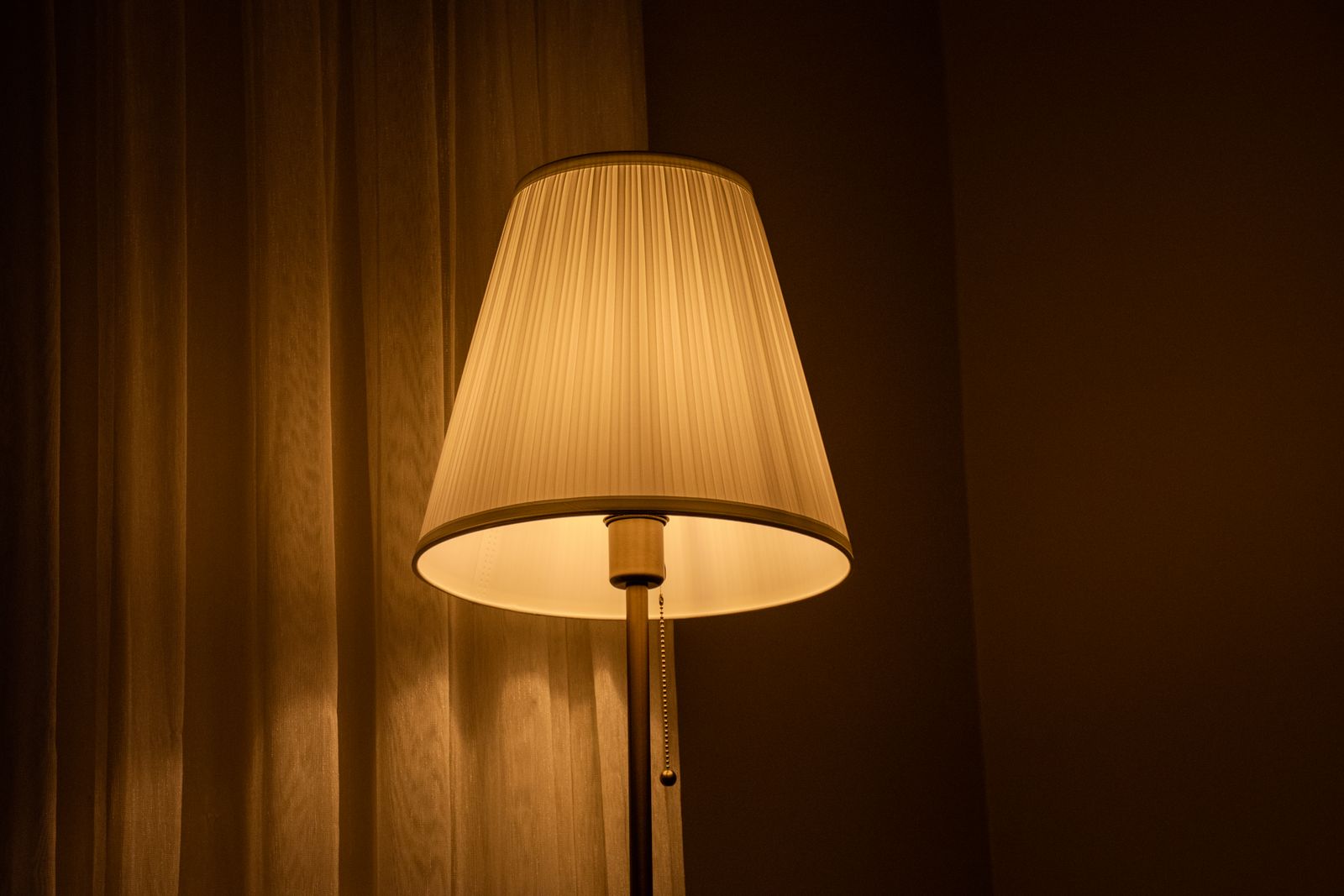
Most rooms feel flat at night for one reason: everything is lit by a single overhead fixture. A ceiling light throws hard, even light from above, flattens faces, creates glare on screens and makes a living room feel like an office. The fix is not expensive designer lamps. It’s using several smaller light sources at different heights, with warmer bulbs and a way to dim them.
This guide covers the three layers of lighting, how to pick bulbs without guessing, where to put lamps in a living room, bedroom and dining area, and the common mistakes that make a space feel cold. There’s a short checklist at the end.
Why one overhead light makes a room feel wrong
Light from a single point above you does three unflattering things. It casts shadows under eyes and chins, it lights the floor and tabletops more than the walls, and it leaves corners dark, which makes a room look smaller. Our eyes read a space as comfortable when the walls and corners are softly lit and the brightest light sits roughly at seated eye level or below.
That’s why hotel rooms and good restaurants rarely rely on a ceiling fixture after dark. They use lamps, wall lights and small accent lights spread around the room. You can do the same at home with what you probably already own plus two or three additions.
The three layers: ambient, task and accent
Lighting designers talk about layers. You don’t need the jargon, but the idea is useful because each layer does a different job.
Ambient light: the base level
Ambient light is the general glow that lets you move around without bumping into furniture. In most homes it comes from the ceiling, but at night it’s better supplied by floor lamps, table lamps with fabric shades, or light bounced off the ceiling by an uplighter. The goal is even, soft light with no glare.
Task light: where you actually do things
Task light is focused and brighter: a reading lamp next to your chair, under-cabinet lights in the kitchen, a desk lamp. It should hit the page, the cutting board or the keyboard, not your eyes. An adjustable arm or a shade that directs light downward helps.
Accent light: what gives a room character
Accent light picks out something specific: a picture, a bookshelf, a plant, a textured wall. A small spotlight, a picture light or a lamp placed behind a plant creates depth and gives the eye somewhere to land. One or two accents per room are usually enough.

Choosing bulbs: color temperature, brightness and color quality
Most lighting problems are bulb problems. Three numbers on the box tell you almost everything.
Color temperature (Kelvin)
Color temperature describes how warm or cool white light looks. Lower numbers are warmer and more yellow; higher numbers are cooler and more blue.
| Kelvin range | How it looks | Best used for |
|---|---|---|
| 2200K–2700K | Warm, close to incandescent or candlelight | Living rooms, bedrooms, dining, evenings |
| 3000K | Soft white, slightly cleaner | Kitchens, bathrooms, reading lamps |
| 3500K–4000K | Neutral white | Garages, workshops, home offices during the day |
| 5000K and up | Cool, bluish daylight | Task areas where color checking matters; rarely comfortable at home at night |
For living spaces, staying at 2700K or below is the simplest rule. Mixing a 2700K lamp with a 5000K ceiling light in the same room is one of the most common reasons a space feels “off.”
Brightness (lumens, not watts)
LED bulbs list brightness in lumens. As a rough guide, a bulb sold as a “60W equivalent” is around 800 lumens and a “40W equivalent” is around 450. Several lower-output lamps around a room usually feel better than one very bright source. If a lamp seems harsh, try a lower-lumen bulb before replacing the lamp.
Color quality (CRI)
CRI, or color rendering index, measures how accurately a light shows colors. Many inexpensive LEDs are around 80, which can make skin, wood and food look slightly dull. Bulbs rated 90 or higher show colors more naturally and are worth it for the lamps you sit near.
Dimming changes everything
A dimmer turns one lamp into several moods. You have a few options:
- Wall dimmers: replace a standard switch. Make sure both the dimmer and the bulbs are labeled as compatible, or LEDs may flicker or buzz. If you’re not comfortable with wiring, hire an electrician.
- Plug-in or inline dimmers: sit between a lamp and the outlet. No wiring, and easy to move.
- Dimmable smart bulbs: controlled from a phone, a remote or a schedule. Some can also shift color temperature, so the same bulb can be cooler in the afternoon and warmer at night.
- Lamps with built-in dimmers: convenient for a reading chair or bedside.
Check that a bulb says “dimmable” on the package. Non-dimmable LEDs on a dimmer are the most common cause of flicker.
Room by room: where the light should go
Living room
Aim for at least three light sources at different points in the room, so no corner goes dark. A typical setup is a floor lamp beside the sofa or reading chair, a table lamp on the opposite side of the room, and one accent light on a shelf, plant or artwork. Shades should sit roughly at or just below seated eye level so you see a glow, not a bare bulb. If you have a ceiling fixture, keep it for cleaning and searching for lost keys.
Bedroom
Bedside lamps on both sides, ideally on dimmers or with low-output bulbs, handle almost everything. A warm, low light in the evening is easier on the eyes before sleep than bright overhead light. If you read in bed, choose a lamp with a directional shade or a wall-mounted swing-arm so the light falls on the page and not into your partner’s eyes.
Dining area
A pendant or chandelier over the table works well if it’s on a dimmer and hung low enough that the light pools on the table rather than in your eyes. A common guideline is roughly 30 to 36 inches between the tabletop and the bottom of the fixture, adjusted for ceiling height. Add a lamp on a sideboard or a couple of candles and the space feels like somewhere you want to linger.
Entry and hallway
A small lamp on a console table or a low-output wall light makes coming home at night feel welcoming and keeps you from switching on every overhead light in the house.
Lamps worth owning, and what to look for
You don’t need many lamps, but the ones you buy should be solid. Look for a heavy, stable base, a switch that feels positive rather than flimsy, a cord long enough to reach the outlet without an extension, and a shade that fully hides the bulb from where you sit. Fabric and paper shades diffuse light softly; metal shades direct it downward for reading.
Lamps are also one of the best things to buy secondhand. Older lamps with metal, ceramic or wood bodies are often better built than new flat-pack versions, and rewiring a lamp with a new cord and socket is inexpensive at most lighting or repair shops. Have older wiring checked before regular use.
From experience: The advice I give younger men about clothes applies to lamps too: buy pieces that last, vintage is perfectly fine, and mixing and matching is fine. A well-made older lamp next to a newer one usually looks more personal than a matching set from one store.
For more on judging construction before you pay, see our guide on how to judge quality before you buy anything.
Common mistakes
- Using cool daylight bulbs (5000K or more) in living spaces.
- Relying on one bright fixture instead of several smaller sources.
- Mixing different color temperatures in the same room.
- Exposed bulbs at eye level that cause glare.
- Putting all the lamps on one side of the room and leaving the other side dark.
- Buying non-dimmable LEDs for a dimmer circuit.
Lighting for guests
When people come over, lighting does as much for the evening as the food. Lower the overall level, turn on the lamps and accents, and switch off the ceiling light. If guests are staying overnight, leave a lamp or night light in the hallway and bathroom so they can find their way without searching for switches. Our guide to hosting houseguests with genuine grace covers the rest, and if drinks are part of the plan, see the cocktail kit every home bar needs.
Quick checklist
- At least three light sources in the main living space, at different heights.
- Warm bulbs (2700K or below) in living rooms and bedrooms.
- CRI 90+ bulbs in the lamps you sit closest to.
- Dimmers or dimmable bulbs on the main lamps.
- One or two accent lights on artwork, shelves or plants.
- Ceiling light off after dark unless you’re cleaning or searching.
FAQ
What color temperature is best for a living room?
For evenings, 2200K to 2700K gives a warm, relaxed light similar to incandescent bulbs. Some people like 3000K for a slightly crisper look. The key is keeping all the bulbs in the room close to the same temperature.
How many lamps does a living room need?
Most living rooms feel balanced with three to five light sources spread around the room, such as one or two floor lamps, one or two table lamps and an accent light. Larger rooms need more.
Are smart bulbs worth it?
They’re useful if you want to dim lamps without installing wall dimmers, set schedules, or change color temperature through the day. A plain dimmable LED on a plug-in dimmer does most of the job for less money.
Is it safe to use old or vintage lamps?
Usually, if the wiring is in good condition. Check for cracked or stiff cords, loose sockets and missing strain relief. If in doubt, have the lamp rewired by a qualified repair shop before regular use.
Updated November 2026. Some links on this site may be affiliate links; see our editorial policy.