If you spend most of the day in a chair, your body adapts to it. Hip flexors shorten, hamstrings tighten, the upper back rounds and the neck drifts forward toward the screen. None of this happens overnight, and none of it is fixed overnight either. But a short, consistent routine can make a noticeable difference in how you feel getting out of a car, bending to tie your shoes or standing up after a long meeting.
The routine below takes about 15 minutes, needs only a mat or a rug, and uses basic yoga poses that suit beginners. Do it in the evening, after work or first thing in the morning.

What sitting does to your body
- Hips: The muscles at the front of the hip stay in a shortened position for hours. Many men feel this as stiffness when they stand up straight.
- Hamstrings: Sitting with bent knees can leave the back of the thighs tight, which makes forward bending feel restricted.
- Upper back and chest: Reaching for a keyboard pulls the shoulders forward and rounds the upper spine.
- Neck: Looking down at a laptop or phone loads the neck and upper shoulders.
- Glutes: They do very little while you sit, so they often feel weak or slow to switch on.
A good desk-worker routine reverses each of these: it opens the front of the hips, lengthens the hamstrings, extends the upper back, gently moves the neck and wakes up the glutes.
Before you start
- Move slowly and breathe steadily through the nose. Each breath should be calm and unforced.
- Aim for a stretch you would rate around 5 out of 10, never sharp or pinching pain.
- Bend your knees whenever the hamstrings or lower back complain.
- Use a cushion, folded towel or block wherever it makes a pose more comfortable.
The 15-minute routine
Hold each pose for the time shown, or for about 5 to 8 slow breaths. Do one side, then the other where noted.
| # | Pose | Time | What it targets |
|---|---|---|---|
| 1 | Cat-cow | 1 minute | Spine, upper back |
| 2 | Child’s pose with side reach | 1 minute | Lats, lower back |
| 3 | Downward-facing dog | 1 minute | Hamstrings, calves, shoulders |
| 4 | Low lunge | 1 minute per side | Hip flexors |
| 5 | Half splits | 1 minute per side | Hamstrings |
| 6 | Low squat | 1 minute | Hips, ankles |
| 7 | Glute bridge | 1 minute | Glutes, front of hips |
| 8 | Thread the needle | 1 minute per side | Upper back, shoulders |
| 9 | Figure-four stretch | 1 minute per side | Outer hips, glutes |
| 10 | Supine twist and rest | 2 minutes | Spine, overall relaxation |
1. Cat-cow
Start on hands and knees, wrists under shoulders and knees under hips. As you breathe in, let your belly drop and lift your chest and gaze (cow). As you breathe out, round your back toward the ceiling and tuck your chin (cat). Move slowly, as if working through each part of the spine in turn.
2. Child’s pose with side reach
Sit your hips back toward your heels with knees apart and arms stretched forward. After a few breaths, walk both hands to the right to feel a stretch along the left side of your back, then switch. A cushion under your hips helps if they do not reach your heels.
3. Downward-facing dog
From hands and knees, tuck your toes and lift your hips up and back so your body forms an inverted V. Keep your knees bent at first and focus on a long spine. Pedal your feet, bending one knee then the other, to ease into the calves and hamstrings.
4. Low lunge
Step your right foot forward between your hands and lower your left knee to the mat (pad it with a towel). Keep your torso upright and gently tuck your tailbone, then shift your hips forward until you feel a stretch at the front of the left hip. This is the most important pose in the routine for desk workers. Switch sides.
5. Half splits
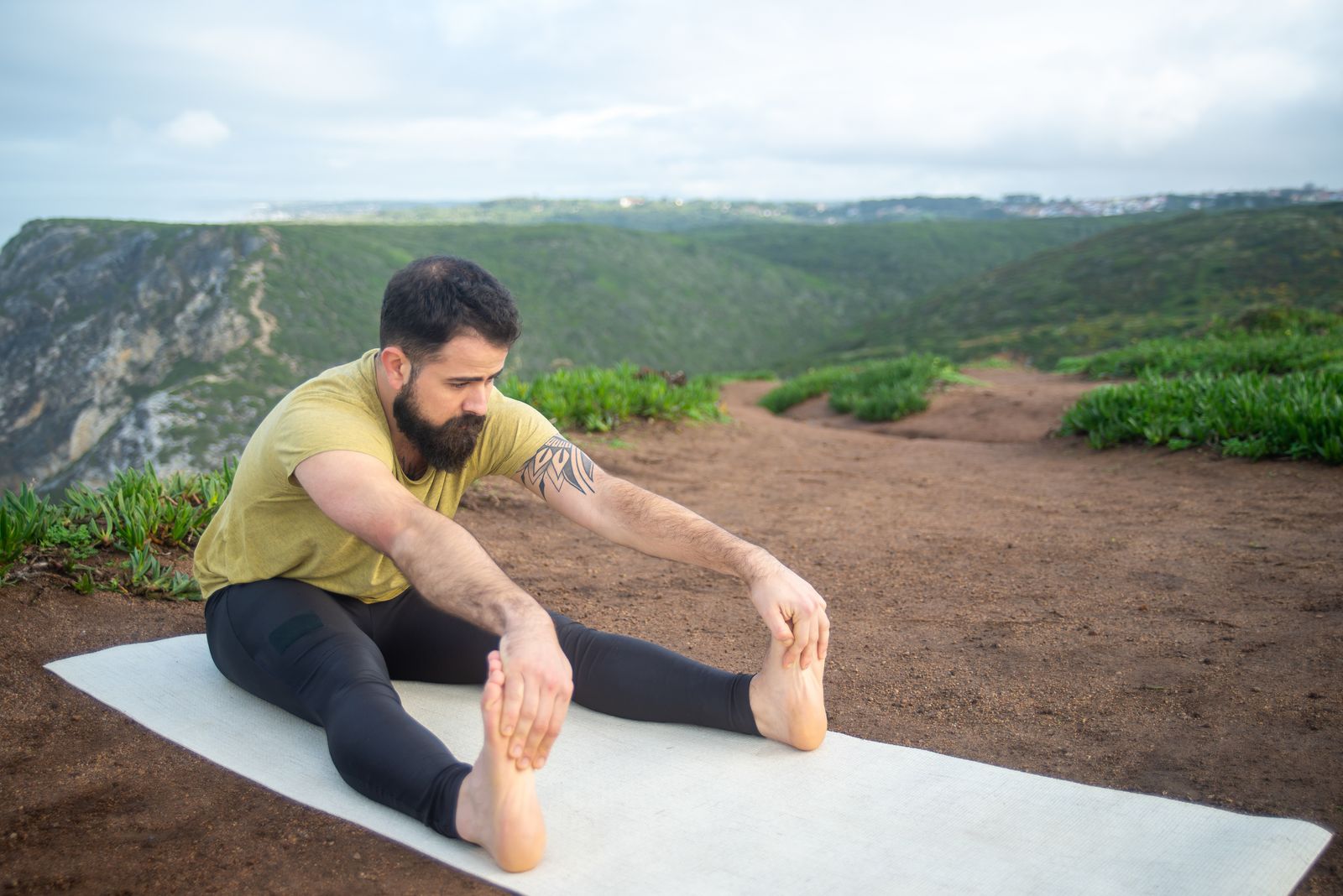
From the low lunge, shift your hips back over your rear knee and straighten your front leg, flexing the foot. Keep your back long and hinge forward only as far as you can without rounding. Hands can rest on blocks or books. Switch sides.
6. Low squat
Stand with feet a bit wider than your hips, toes turned slightly out, and sit down into a deep squat. Rest your elbows inside your knees with palms together. If your heels lift, put a rolled towel under them or hold onto a doorframe for balance.
7. Glute bridge
Lie on your back with knees bent and feet flat, hip-width apart. Press through your heels to lift your hips until your body forms a straight line from knees to shoulders, squeezing your glutes at the top. Lower slowly and repeat 8 to 10 times, then hold the top position for a few breaths.
8. Thread the needle
Return to hands and knees. Slide your right arm under your left, palm up, and lower your right shoulder and the side of your head to the mat. Let the upper back rotate and relax. Switch sides.
9. Figure-four stretch
Lie on your back, cross your right ankle over your left knee, and draw your left thigh toward your chest. You should feel it in the outer right hip and glute. Switch sides.
10. Supine twist and rest
Hug both knees in, then let them fall to one side while your arms rest out wide and your shoulders stay down. Switch sides after about 30 seconds each. Finish by lying flat for a minute, breathing slowly.

Quick resets during the workday
The full routine works best once a day, but short breaks help in between. Every hour or so, stand up and try one or two of these:
- Standing hip flexor stretch: Step one foot back, tuck your tailbone and press the hips forward.
- Doorway chest stretch: Place your forearms on a doorframe and step through gently.
- Seated twist: Sit tall and rotate toward the back of your chair, holding the backrest.
- Chin tucks: Draw your chin straight back to make a “double chin,” hold for a few seconds and release.
- Walk: A two-minute walk to refill water does as much as any stretch.
Your setup matters too. A screen at eye level and a chair that lets your feet rest flat reduce how much you need to undo later; see our notes on what belongs on a man’s desk. For strengthening work that complements this routine, read the best exercises to improve posture.
A simple weekly plan
| Day | What to do |
|---|---|
| Monday, Wednesday, Friday | Full 15-minute routine |
| Tuesday, Thursday | Low lunge, half splits and thread the needle only (5 minutes) |
| Weekend | A longer walk, a hike, or a beginner yoga class |
If you are new to yoga in general, our practical beginner’s guide to yoga for men explains styles and what to expect in a class.
Common mistakes
- Bouncing into stretches. Ease in and hold instead.
- Rounding the back to go deeper. In forward bends, a long spine matters more than how far you reach.
- Doing it once a week. Short and frequent beats long and rare for undoing hours of sitting.
- Skipping the glutes. Stretching alone is not enough; the bridge helps reawaken muscles that switch off when you sit.
Key takeaways
- Sitting tightens the hips and hamstrings and rounds the upper back; this routine targets each area.
- The low lunge and glute bridge do the most for desk workers.
- Keep stretches moderate, breathe steadily and use props freely.
- Consistency over weeks matters far more than intensity on any single day.
FAQ
Is it better to do this in the morning or evening?
Either works. Morning sessions can ease stiffness after sleep; evening sessions help undo a day of sitting and may help you wind down. Pick the time you can stick to.
How long before I notice a difference?
Many people feel looser immediately after a session. Lasting changes in mobility usually take several weeks of regular practice.
Can I do this routine every day?
Yes. These are gentle, low-intensity poses. If anything causes pain rather than a stretch, skip it and consider asking a physical therapist for an alternative.
This article is general information, not medical advice. If you have back, hip or neck pain, an injury or a health condition, check with a doctor or physical therapist before starting a new routine.
Updated November 2026. Some links on this site may be affiliate links; see our editorial policy.