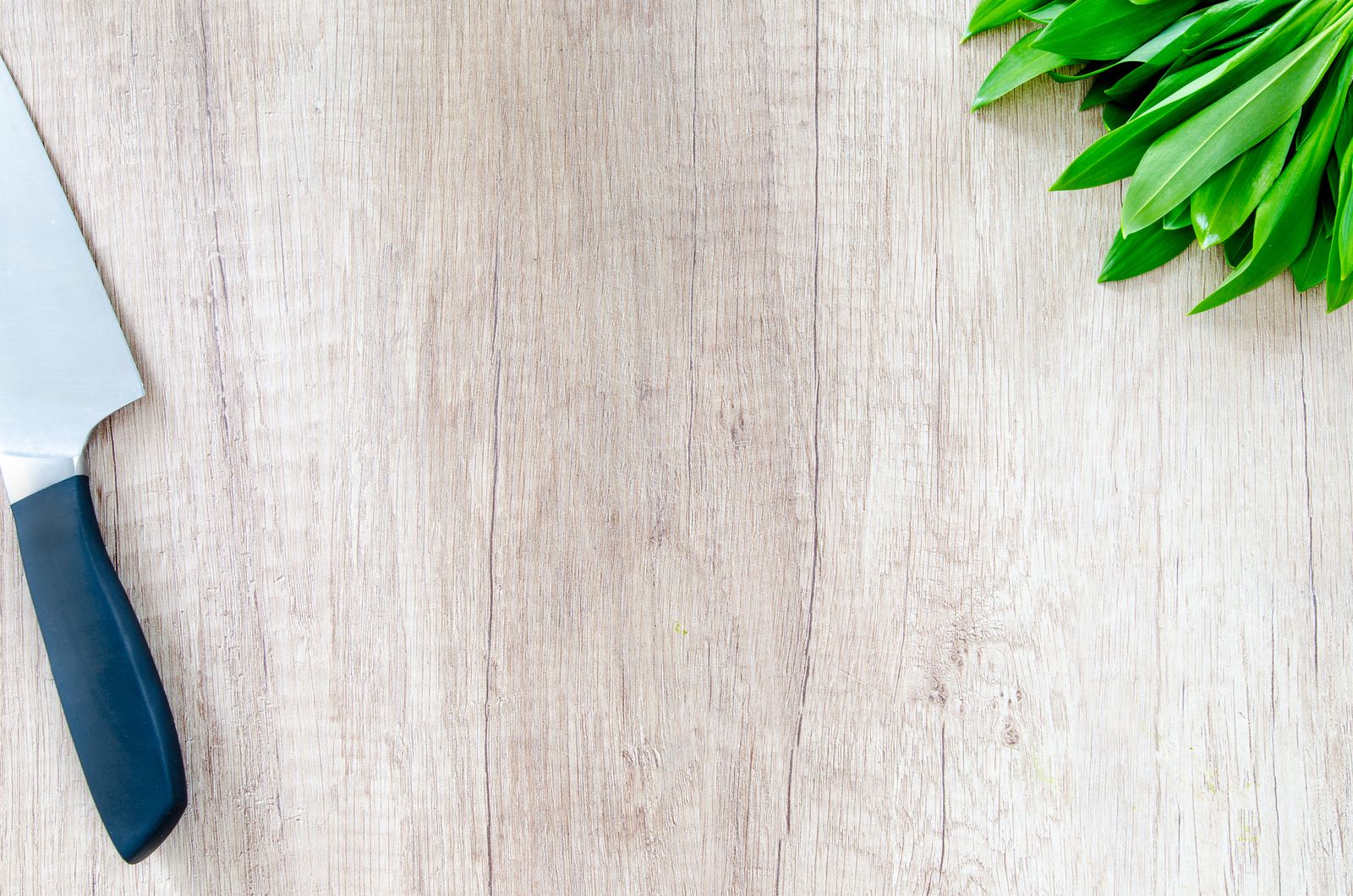
If you could own only one kitchen knife, it should be a chef’s knife. It slices, dices, minces and chops, and it handles about nine out of ten jobs in a home kitchen. A good one, sharpened and cared for, can last the rest of your life.
The trick is that “good” depends more on fit and maintenance than on price. This guide explains the styles and materials, how to choose one that suits your hand, and how to keep it sharp without a professional.

Western vs. Japanese: the two main styles
Most chef’s knives follow one of two traditions. Neither is better overall; they suit different cooks.
| Western (German-style) | Japanese (gyuto) | |
|---|---|---|
| Typical length | 8 inches (about 20 cm) | 210 mm (about 8.3 inches) |
| Blade | Thicker, heavier, more curved belly | Thinner, lighter, flatter profile |
| Steel | Softer, tougher stainless | Harder steel that holds an edge longer |
| Edge angle | Wider, more durable | Narrower, sharper, more delicate |
| Best for | Rocking cuts, heavier tasks, less careful users | Precise slicing, push and pull cuts |
| Care | Forgiving; tolerates more abuse | Avoid bones, twisting and frozen food |
Well-known, widely available examples include Wüsthof and Zwilling on the Western side, Global, Mac, Shun and Tojiro on the Japanese side, and Victorinox for an inexpensive, lightweight option that many professional kitchens use.
What to look for in the blade
Steel
- Stainless steel: resists rust and staining and is the easiest to live with. Most knives sold today are stainless.
- Carbon steel: takes a very sharp edge and is easy to sharpen, but it rusts if left wet and develops a dark patina over time. Better suited to people who enjoy maintenance.
- Harder vs. softer steel: harder steel holds an edge longer but is more brittle and can chip. Softer steel dulls faster but is easier to hone and more forgiving.
Forged or stamped
Forged blades are shaped from heated steel and are often heavier, with a bolster where the blade meets the handle. Stamped blades are cut from a sheet and are usually lighter. Construction alone doesn’t decide quality: some excellent knives are stamped, and some poor ones are forged. The steel, heat treatment and fit matter more.
Length
An 8-inch (or 210 mm) blade suits most people and most cutting boards. A 10-inch blade gives more reach for big jobs but can feel unwieldy in a small kitchen. A 6-inch knife is easier to control but limits what you can cut in one stroke.
Fit matters more than the brand
A knife you enjoy holding is a knife you’ll use well. If you can, handle a few before buying.
- Grip: most cooks hold a chef’s knife with a pinch grip, thumb and forefinger on the blade just ahead of the handle. Check that this feels natural.
- Balance: many people prefer a knife that balances near the bolster or the start of the handle. Lighter knives can feel nimble; heavier ones do more of the work.
- Knuckle clearance: with the edge flat on a board, your knuckles shouldn’t hit the board when you grip the handle.
- Handle: it should feel secure when wet, with no gaps between the handle and the tang.
From experience: With watches, I’ve always believed in buying from makers with provenance and real technology that focus on one thing and do it well. It’s a useful filter for knives too: a company with a long record of making blades is usually a safer bet than a brand that sells a bit of everything.
Keeping it sharp: honing vs. sharpening
These are two different jobs, and most dull knives need the first, not the second.
- Honing realigns an edge that has rolled slightly during use. A honing rod does this in a few seconds. Do it often, even every time you cook.
- Sharpening removes metal to create a new edge. Depending on how much you cook, that might be every few months to once a year.
Whetstones give you the most control and work on almost any knife. A combination stone with a medium and fine side is a good start. Hold a consistent angle, work along the full edge and finish on the finer side. Pull-through sharpeners are faster but remove more metal and are less precise; if you use one, use it lightly. A local professional sharpening service is also a sensible option.
A quick test: slice a sheet of paper or a ripe tomato. A sharp knife cuts cleanly without tearing or skating off the skin.
Care habits that make a knife last
- Wash by hand and dry immediately. Dishwashers dull edges and can damage handles.
- Use a wood or plastic board. Glass, stone, marble and ceramic surfaces dull edges quickly.
- Store it safely: a magnetic strip, a block or an edge guard. A loose knife in a drawer chips the edge and is a hazard.
- Use the spine to scrape food across the board, not the edge.
- Pick the right tool: avoid bones, frozen food and hard squash rinds with thin Japanese blades.
If you carve roasts at the table, our guide on how to carve a roast covers technique. For an everyday blade outside the kitchen, see the pocketknife every man should carry, and for the pan that goes with it, our guide to cast iron cookware.
Basic technique that protects your fingers and your edge
- The claw grip: curl the fingertips of your guiding hand under, so your knuckles rest against the flat of the blade and guide it. Your fingertips stay out of the way.
- Let the blade do the work: use a smooth forward or backward motion rather than pressing straight down. A sharp knife needs little force.
- Stabilize round food: cut a thin slice off one side of an onion or potato so it sits flat before you keep cutting.
- Steady the board: a damp towel underneath stops the cutting board from sliding.
A dull blade needs more force and is more likely to slip, which is why cooks generally consider a sharp knife the safer one. Keeping the edge sharp is a safety habit as much as a quality one.
Buying checklist
- Choose Western or Japanese style based on how you cut and how much care you’ll give it
- Start with an 8-inch or 210 mm blade
- Stainless steel unless you want to manage carbon steel
- Comfortable pinch grip, secure handle, enough knuckle clearance
- A honing rod and a plan for sharpening
- A wood or plastic cutting board and safe storage
Frequently asked questions
Do I need a full knife set?
No. A chef’s knife, a paring knife and a serrated bread knife cover almost everything a home cook does. Sets often include pieces that rarely get used.
How often should I sharpen my chef’s knife?
Hone it regularly, ideally each time you cook. Sharpen when honing no longer restores a clean cut, which for most home cooks is every few months to once a year.
Is an expensive knife worth it?
Sometimes, but an inexpensive knife that is kept sharp will outperform an expensive one that is dull. Spend first on fit and maintenance, then on better steel if you cook often and enjoy it.
Updated November 2026. Some links on this site may be affiliate links; see our editorial policy.